by Terry Heick
High quality– you understand what it is, yet you don’t know what it is. But that’s self-contradictory. But some points are far better than others, that is, they have much more top quality. But when you try to state what the quality is, in addition to things that have it, it all goes poof! There’s absolutely nothing to discuss. Yet if you can not state what Quality is, exactly how do you understand what it is, or just how do you know that it even exists? If nobody knows what it is, after that for all practical purposes it doesn’t exist in all. But for all sensible objectives, it truly does exist.
In Zen and the Art of Bike Upkeep , writer Robert Pirsig speaks about the evasive idea of quality. This principle– and the tangent “Church of Reason”– heckles him throughout guide, significantly as an educator when he’s trying to describe to his students what top quality creating appear like.
After some battling– internally and with trainees– he tosses out letter qualities completely in hopes that trainees will certainly stop searching for the incentive, and begin looking for ‘quality.’ This, certainly, does not end up the means he hoped it ‘d might; the pupils revolt, which just takes him further from his goal.
So what does high quality relate to understanding? Quite a bit, it ends up.
A Shared Sense Of What’s Feasible
High quality is an abstraction– it has something to do with the tension in between a thing and an excellent thing. A carrot and an suitable carrot. A speech and an excellent speech. The means you desire the lesson to go, and the way it actually goes. We have a lot of synonyms for this idea, ‘excellent’ being just one of the a lot more common.
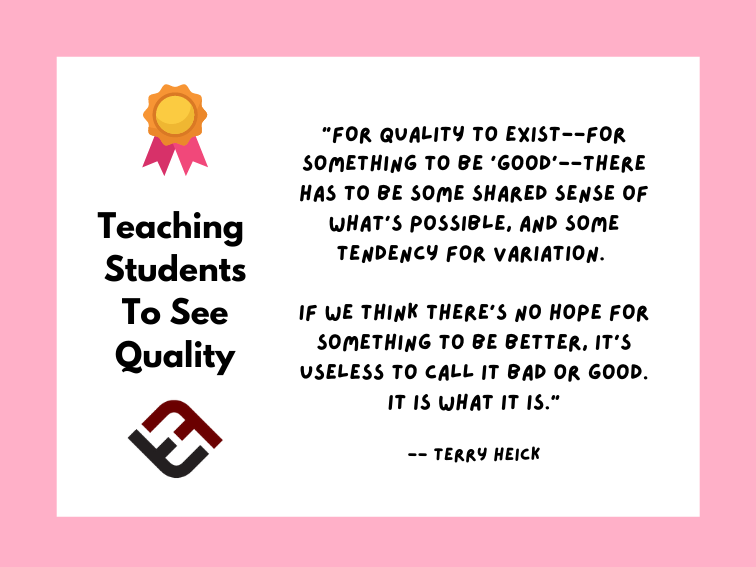
For quality to exist– for something to be ‘good’– there has to be some common sense of what’s possible, and some propensity for variation– variance. As an example, if we assume there’s no wish for something to be better, it’s ineffective to call it poor or excellent. It is what it is. We rarely call walking great or negative. We simply stroll. Vocal singing, on the other hand, can absolutely be great or poor– that is have or lack top quality. We know this due to the fact that we have actually heard great vocal singing prior to, and we know what’s feasible.
Better, it’s challenging for there to be a quality sunup or a top quality drop of water because the majority of sunups and most drops of water are really similar. On the other hand, a ‘top quality’ cheeseburger or performance of Beethoven’s 5 th Harmony makes a lot more feeling because we A) have had a good cheeseburger prior to and recognize what’s possible, and B) can experience a substantial distinction in between one cheeseburger and another.
Back to finding out– if trainees can see quality– identify it, examine it, recognize its features, and so forth– picture what that requires. They need to see right around a thing, contrast it to what’s feasible, and make an analysis. Much of the rubbing in between educators and learners comes from a sort of scraping between trainees and the instructors trying to lead them towards high quality.
The educators, certainly, are only attempting to help students comprehend what top quality is. We define it, produce rubrics for it, aim it out, version it, and sing its commends, yet generally, they don’t see it and we push it more detailed and better to their noses and wait on the light to come on.
And when it doesn’t, we presume they either don’t care, or aren’t striving sufficient.
The most effective
Therefore it goes with loved one superlatives– good, better, and best. Pupils make use of these words without understanding their starting point– high quality. It’s tough to recognize what quality is until they can believe their way around a thing to begin with. And afterwards additionally, to actually internalize points, they have to see their top quality. Top quality for them based upon what they view as possible.
To certify something as good– or ‘finest’– requires initially that we can agree what that ‘point’ is supposed to do, and afterwards can talk about that point in its indigenous context. Take into consideration something straightforward, like a lawnmower. It’s simple to identify the quality of a lawnmower because it’s clear what it’s supposed to do. It’s a device that has some degrees of performance, yet it’s mainly like an on/off switch. It either works or it doesn’t.
Other things, like government, art, technology, etc, are more intricate. It’s unclear what top quality looks like in regulation, abstract painting, or financial management. There is both subtlety and subjectivity in these things that make evaluating high quality much more intricate. In these instances, students have to assume ‘macro enough’ to see the excellent functions of a point, and afterwards choose if they’re functioning, which naturally is difficult since no person can concur with which functions are ‘ideal’ and we’re right back at absolutely no again. Like a circle.
Quality In Pupil Assuming
And so it goes with training and understanding. There isn’t a clear and socially agreed-upon cause-effect connection in between training and the world. Quality training will certainly generate top quality knowing that does this. It coincides with the students themselves– in composing, in reading, and in thought, what does quality resemble?
What causes it?
What are its attributes?
And most importantly, what can we do to not only help pupils see it however establish eyes for it that decline to shut.
To be able to see the circles in whatever, from their very own sense of principles to the method they structure paragraphs, design a job, research study for exams, or resolve troubles in their very own lives– and do so without using adultisms and external tags like ‘great job,’ and ‘outstanding,’ and ‘A+’ and ‘you’re so smart!’
What can we do to nurture students that are happy to sit and dwell with the tension in between opportunity and fact, bending everything to their will minute by minute with affection and understanding?