added by Jean Miller , Ph.D. & & Sharon Hastings , Ed.D, addendum by TeachThought Personnel
Just how around some psychological health and wellness pointers for teachers?
Today, the role of instructors is expanding to consist of more duties and duties than in the past, consisting of building mentally solid and healthy pupils.
Nevertheless, culture usually disregards to attend to or even review the mental and emotional well-being of teachers themselves. This disregard has actually caused 2 significant issues– instructor burn-out and an absence of skilled teachers offered consequently.
See also 5 Errors I Made As A Brand-new Teacher
Given their expanded tasks, growing numbers of instructors are having a hard time to handle the transforming demands of their career. According to a current study of over 30, 000 teachers, performed by the American Federation of Teachers, greater than 75 percent say they do not have sufficient staff to obtain the job done, and 78 percent state they are often physically and mentally worn down at the end of the day.
The factor usually cited for leaving three-quarters of instructors really feeling worn and exhausted was the fostering of brand-new campaigns without appropriate training or specialist advancement.
When it come to the workforce, not only did instructor education and learning enrollment loss by 240, 000 (a 35 percent decline) between 2009 and 2014 yet about eight percent of teachers, including several that are well below the ordinary old age, leave the labor force annually.
One means to suppress this exodus and keep our country’s finest teachers in the classroom is to ensure they have the personal assistance and development they need to stay healthy and satisfied in both their individual and expert lives.
Exactly how To Assistance The Mental Health And Wellness Of Teachers
According to a current University of Phoenix az study on psychological wellness, nearly one-third (31 percent) of U.S. adults surveyed cited social preconceptions as a barrier to receiving mental health care. This is an appropriate and disheartening figure for the education market, as several teachers might additionally share the sentiment that seeking counseling signals weak point or an inability to handle their workload.
The reality is the majority of high-performing instructors battle with the demands of their tasks; in fact, this struggle causes more than 50 percent of them to burn out in much less than 5 years. This stands as additional proof that our sector experts have a vested interest in encouraging educators to seek the assistance they need so they can be happier and much more efficient in their functions.
To give our nation’s instructors with the support they require, psychological wellness sources like specialized therapy, continuing education programs, and neighborhood efforts tailored towards health should be prioritized.
By making mental health care much more easily accessible to instructors, we can aid them move on as specialists and people while making strides to eliminate the stigma frequently related to seeking psychological health and wellness treatment.
A few other psychological health and wellness ideas for instructors?
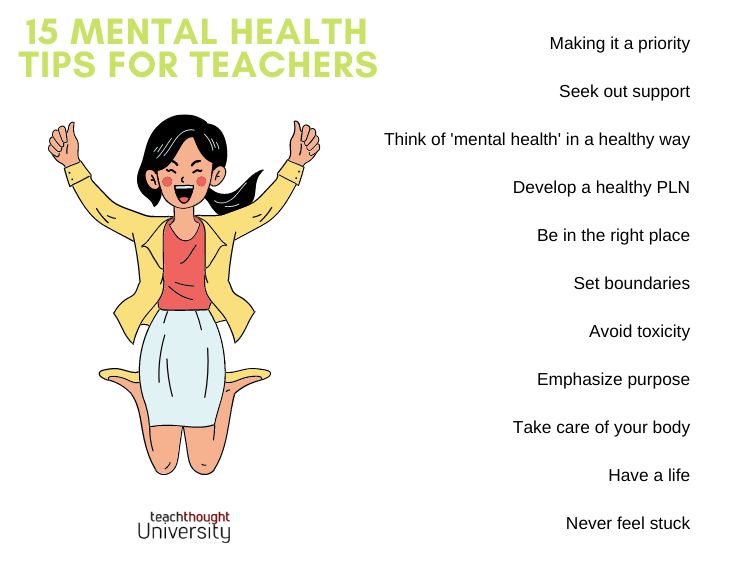
15 Mental Health And Wellness Tips For Teachers
1 Make it a psychological health concern
Most importantly, psychological health and wellness and wellness best practices have to be included into training programs beforehand in instructor education and learning. It depends on college and state qualification boards to take the lead in developing these programs, to make sure that mental health ends up being a top priority in our schools and that all teachers are supplied the resources they need to succeed and remain healthy.
There’s a factor great teachers stopped
2 Look for or develop sources, programs, and plans
Area leaders additionally have a duty to play in developing mental health and health societies in colleges across the country. As a 2nd action, institution systems require to buy the psychological, physical, and social wellness of their most useful property– their educators. By recognizing and rewarding teachers for all that they do (also the ‘little’ points), encouraging the use of tiny teams and therapy, and focusing on mental health, administrators can have a significant, positive impact on the lives of their educators.
3 Mount ‘psychological health and wellness’ in your own mind in a healthy and balanced way
Do not call it ‘mental health’ if an expression like ‘wellness’ makes even more feeling.
4 Grow a healthy and balanced PLN
A strong specialist learning network — both inside and outside of the institution structure.
5 Be in the best location
A job placement that they feel comfy with– i.e., the ‘right’ fit for the educator in regards to placement, grade level, school policies, and so on. Not every task is a suitable for everyone. Well-intentioned people may advice you that the ‘kids need you,’ yet you have to take care of on your own or your training’s simply not lasting.
6 Establish borders
As long as feasible, clear limits between school and home life.
7 Stay clear of toxicity
Avoidance of things– individuals, divisions, boards, occasions, and so on– that are ‘toxic’ while creating methods to deal with various other not-toxic-but-still-challenging mentor circumstances
8 Stress your function
Advise yourself of your objective as a teacher– why you became a teacher. If you’re unable to understand that vision, see if you can fix up that vision with your prompt condition. Otherwise, that offers you a hint of what possibly need to follow.
9 Create a development state of mind as an educator
Growth mindsets matter for students and they matter for teachers, too.
10 Teach with gratefulness
Show with appreciation as long as possible.
11 If you’re able, start little
Focus on the advantages and everyday, attempt to have more good ideas than negative. (That’s a beginning.)
12 Look after your body, too
Take care of yourself physically: exercise, practice meditation, do yoga exercise, obtain enough rest, etc. Whatever it takes for your body to feel excellent.
13 If you require help, obtain aid
Don’t be a hero. If you require official psychological wellness support (in the type of treatment or drug), there’s no reason to wait. Obtain it. Why wait up until you’re really dissatisfied?
14 Have a life outside of teaching
Have a life beyond teaching– one loaded with creative thinking and hope and people and possibility. Despite exactly how nobile training is, it’s not worth your wellness.
15 Do not really feel stuck
If possible, never get ‘stuck’ where you feel like you ‘need to’ teach or ‘can not quit.’ There’s always a way forward. Anytime anyone feels ‘stuck,’ it can convince you your scenario is even worse than it actually is.
Educators are functioning daily to develop psychologically strong and healthy and balanced kids, molding the future generation of leaders and change-makers. As educators’ duties continue to expand at a fast rate, we must do all we can to support their psychological health. We should sustain the ‘whole teacher.’
By giving the psychological support our educators so desperately require and be entitled to, we can help them grow properly and live happier lives all while combating the instructor shortage in America that is placing a stress on the whole education and learning system.
Dr. Jean Miller is the University’s Denver University College Chair, and Dr. Sharon Hastings is the medical supervisor and manager of the Therapy Clinic at University of Phoenix Az; Expanding The Entire Educator: Mental Health And Wellness In Education ; 13 Mental Wellness Tips For Educators