by Terry Heick
Humbleness is a fascinating starting point for understanding.
In a period of media that is electronic, social, sliced up, and endlessly recirculated, the obstacle is no longer access yet the top quality of accessibility– and the reflex to after that evaluate unpredictability and “truth.”
Discernment.
On ‘Knowing’
There is an appealing and warped sense of “recognizing” that can bring about a loss of respect and even entitlement to “recognize things.” If absolutely nothing else, modern-day innovation gain access to (in much of the globe) has replaced subtlety with phenomenon, and procedure with access.
A mind that is appropriately watchful is likewise properly simple. In A Native Hill , Wendell Berry indicates humbleness and limitations. Standing in the face of all that is unknown can either be frustrating– or lighting. Just how would certainly it change the understanding process to begin with a tone of humbleness?
Humbleness is the core of important thinking. It claims, ‘I do not know enough to have an informed viewpoint’ or ‘Allow’s learn to minimize uncertainty.’
To be self-aware in your very own understanding, and the limits of that knowledge? To clarify what can be understood, and what can not? To be able to match your understanding with an authentic demand to know– job that naturally enhances crucial assuming and sustained query
What This Appears like In a Classroom
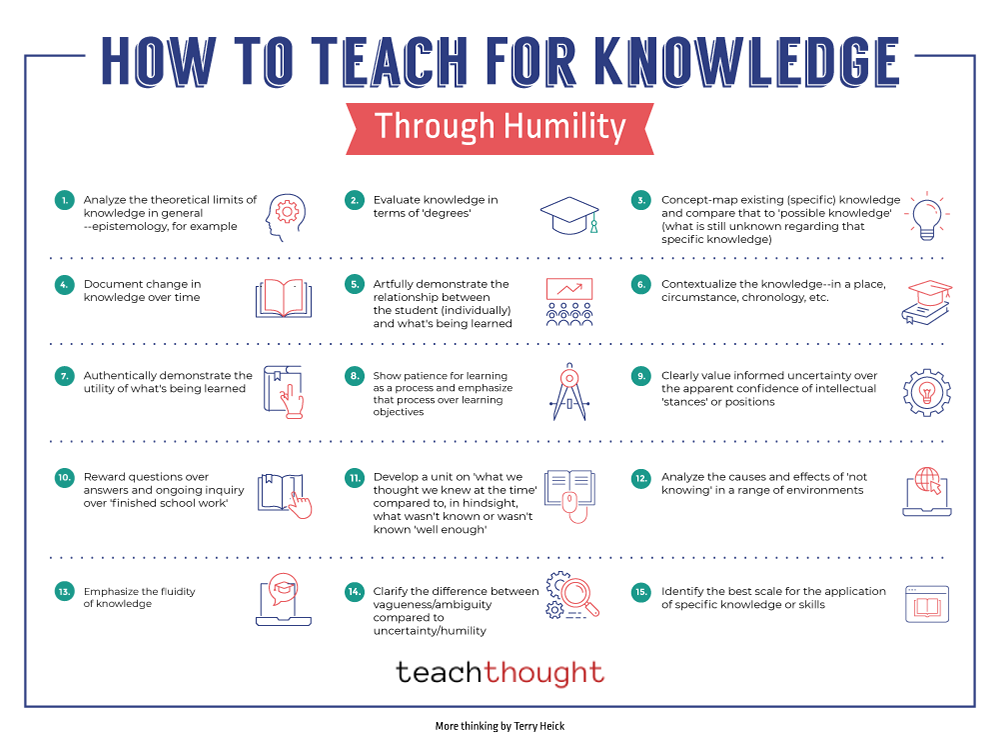
- Evaluate the restrictions of expertise in plain terms (a simple intro to epistemology).
- Evaluate expertise in levels (e.g., particular, potential, feasible, not likely).
- Concept-map what is currently comprehended concerning a particular topic and compare it to unanswered concerns.
- Paper how understanding changes with time (individual learning logs and historic pictures).
- Show how each pupil’s viewpoint forms their partnership to what’s being discovered.
- Contextualize expertise– location, scenario, chronology, stakeholders.
- Show genuine utility: where and exactly how this expertise is used outside college.
- Show patience for learning as a procedure and stress that procedure together with purposes.
- Clearly value educated uncertainty over the self-confidence of fast verdicts.
- Award continuous questions and follow-up examinations greater than “ended up” answers.
- Produce a system on “what we thought we knew then” versus what hindsight reveals we missed.
- Assess causes and effects of “not recognizing” in science, history, civic life, or everyday choices.
- Highlight the liquid, evolving nature of understanding.
- Set apart vagueness/ambiguity (absence of clearness) from uncertainty/humility (understanding of limitations).
- Identify the very best range for applying details knowledge or abilities (person, neighborhood, systemic).
Study Note
Research shows that people that exercise intellectual humbleness– being willing to confess what they don’t know– are more available to finding out and less most likely to cling to false assurance.
Source: Leary, M. R., Diebels, K. J., Davisson, E. K., et al. (2017 Cognitive and social features of intellectual humbleness Personality and Social Psychology Notice, 43 (6, 793– 813
Literary Touchstone
Berry, W. (1969 “A Native Hillside,” in The Long-Legged Home New York: Harcourt.
This concept may appear abstract and even out of location in progressively “research-based” and “data-driven” systems of understanding. However that belongs to its worth: it helps students see knowledge not as fixed, however as a living procedure they can accompany treatment, proof, and humbleness.
Mentor For Understanding, Understanding Via Humility